Table of Contents
- The Panic of a Dubai Flash Flood: Why the Next 30 Minutes Determine Your Car’s Survival
- Minutes 0–5: The Golden Rule of Flood Survival
- Minutes 5–15: Critical Documentation for Insurance and Resale Value
- Minutes 15–30: Navigating Dubai’s Administrative Process
- Why Luxury Vehicles Are at Higher Risk
- The Science of Water Damage Inside the Engine Bay
- Post-Crisis Recovery: Professional Triage and Inspection
- The Silent Killers: Long-Term Damage and Resale Value
- A 30-Minute Action Plan to Save Your Investment
- Frequently Asked Questions (FAQs)
Quick answer: If your luxury car floods in Dubai, do not attempt to start the engine. Shut off all power immediately, document the damage with photos and video, file a report via the Dubai Police app, request a TWIMC certificate, and contact your insurance provider - all within 30 minutes. Speed and sequence are everything.
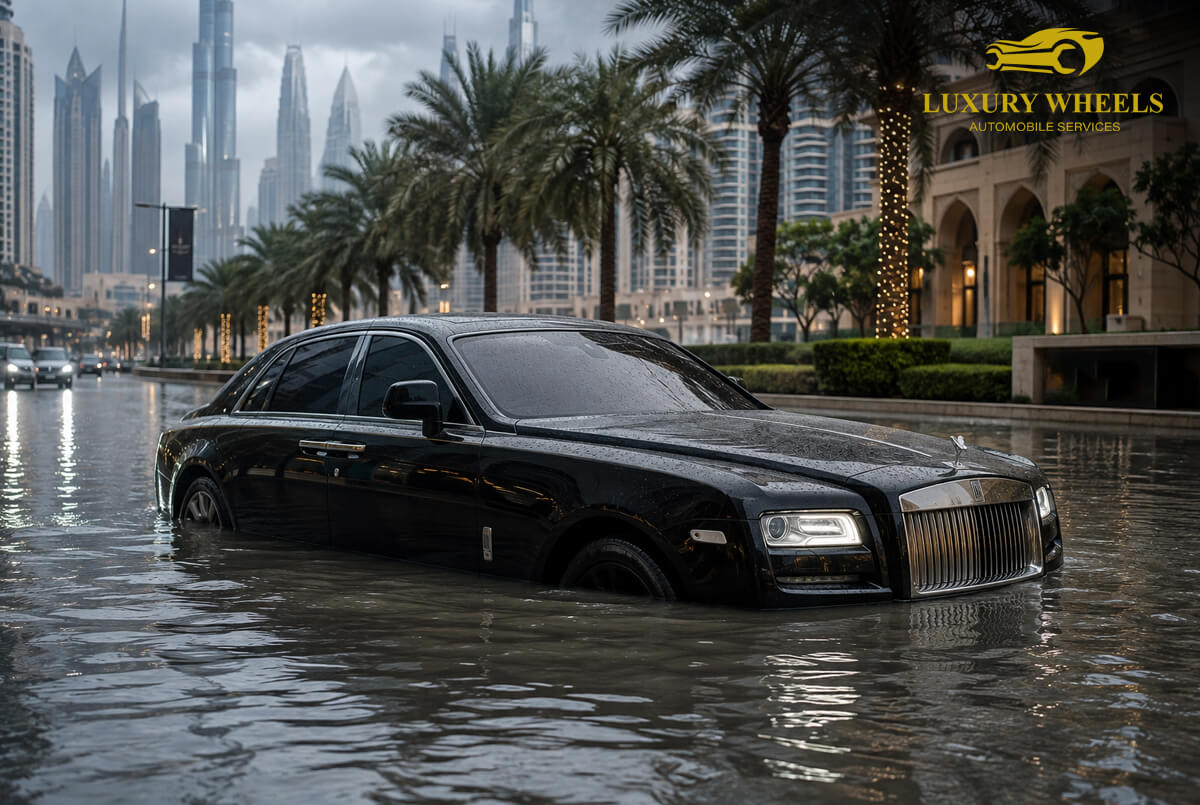
Dubai's April 2024 storms left thousands of vehicles submerged across the emirate - many of them high-value German and British luxury cars. Rainfall records were shattered. Roads turned into rivers. And owners of Mercedes-Benz, BMW, Range Rover, Porsche, Audi, and Bentley vehicles faced a decision they never expected: what do you actually do when your luxury car is sitting in floodwater?
The difference between a full recovery and a written-off vehicle often comes down to the first 30 minutes. Make the wrong moves - starting the engine, waiting for the water to recede, or calling a standard recovery truck - and you can transform a repairable situation into a total loss.
This guide is built for Dubai residents who own premium vehicles and need fast, accurate, expert-level guidance. It covers every critical step from the moment floodwater enters your car, through the documentation, insurance, and professional recovery process, to the long-term risks most owners never consider until it's too late.
If you're reading this mid-crisis, start at the top. Every minute counts.
The Panic of a Dubai Flash Flood: Why the Next 30 Minutes Determine Your Car's Survival
The High Stakes of Luxury Vehicle Ownership in Natural Disasters
Having a high-end car is to possess one of the most intricate machines available on UAE roads. That complexity, all those stacked ECU networks, the active suspension components and high-compression engines wound to 11, with kilometers of precision wiring - is exactly what makes luxury cars such rich targets when it comes to water intrusion.
Only tier minor flooding may cause little damage to a mid-range saloon. And a Porsche Cayenne or a BMW 7 Series almost certainly won't. The more advanced the vehicle, the quicker water damage accelerates. Failure of electronic control units in minutes after exposure. Some parts can rust way before the car dries.
In May, you may remember the flash flooding that resulted in $45 million worth of car damage spread across a reported 500 vehicles. And satellite data from the UAE National Center of Meteorology shows that April's rainfall event - 254mm in 24 hours in some spots - was the heaviest recorded in the UAE for 75 years. Such events are no longer once-in-a-generation one-offs.
Why Sheikh Zayed Road and Al Manara Street Present Unique Flooding Risks
Underpasses and low-lying stretches along Sheikh Zayed Road are well-known collecting pools for flash flood water. Similarly, parts of Al Manara Street and Al Quoz as well as some local arterial roads are susceptible to flooding. We're not talking fringe areas of Dubai here, either - these are some of the busiest corridors that happen to be lined with top-end, high-density car traffic.
Even many expat residents don't know that Dubai's drainage systems - while expanding - were never engineered to cope with such extreme precipitation events. Responsible ownership in the gradually warming climate of the UAE also involves understanding where your car is under the greatest threat and taking appropriate steps.
Minutes 0–5: The Golden Rule of Flood Survival
The Do Not Start Mandate: Avoiding Catastrophic Hydrolocking
This is the single most important rule: do not attempt to start your engine. Not once. Not even to "test it."
Hydrolocking is when water gets sucked into the combustion chamber of the engine. Because water has far less volume to compensate for the pressure that air and fuel can fill up with, we know water is not compressible. When a piston tries to compress water, it just stops - and often with enough force to bend connecting rods, crack cylinder heads, or destroy the engine completely. Repairing a high-performance engine with damage from hydrolock can cost upwards of AED 80,000 up to 150,000, and in many circumstances the engine is not worth repairing.
One of the quickest ways to escalate a potentially recoverable flood-damage situation into a total loss is to start the vehicle.
Immediate Power Shutdown: Protecting the Battery and Electrical Systems
As long as it can be done safely, disconnect the negative terminal of your battery right away. It breaks the electrical circuit so you don't have a short circuit that cascades through your vehicle's wiring harness.
Luxury vehicles today - especially those with start-stop systems, hybrid powertrains, or air suspension - always have voltage present at more than one module. Water in conjunction with energised electricity is a truly devastating cocktail that can weld contactors together, fry control units and wreck components for ever more than what would be the long-term impact of submersion.
If you cannot safely get to where the battery is but can still disconnect it, then do not use any other functionality of the vehicle - lights, windows, climate control (to inflow and outflow air) & generating heat.
Prioritizing Personal Safety: When to Stay and When to Abandon the Vehicle
Get out of the vehicle as soon as possible if floodwater is continuing to rise. A luxury car is replaceable. A sealed-in cabin filling with fast-flowing water is lethal, especially in places like underpasses where water can rise to fill the space in seconds.
After getting out and moving to a safe area, gather your documents - Emirates ID, registration card and insurance papers if available - then head to higher ground. Start documenting the damage only if you are confident that the water level has stabilized.
Minutes 5–15: Critical Documentation for Insurance and Resale Value
Identifying the Water Level: Mapping High-Water Marks on the Bodywork
Photograph & mark the exact waterline on the outside of your vehicle before floodwaters recede. Evidence of the highest water mark is one of the most valuable elements of your insurance claim and damage severity assessment.
You also write down the internal waterline. Look for any signs of water damage on the seat fabric, door panels, the centre console, footwells and the boot. These markings will inform your assessor precisely how deep the submersion was, which is important to know before determining which systems are most likely to be impaired.
Photographic Evidence: What Your Insurance Company Needs to See Immediately
The best way to ensure a smooth process when filing your Dubai motor insurance claim for flooded car damage due to sudden flooding is to photograph the vehicle comprehensively, capturing it before elements are washed away. Take note of the following by taking out your phone.
- Exterior waterline - all four sides of the vehicle, including door sills and wheel arches
- Interior - all footwells, seats, dashboard, boot area, and any visible water pooling
- Engine bay - photograph before opening the bonnet fully; capture any visible water or debris
- Surrounding environment - street signs, landmarks, other affected vehicles, and road conditions to confirm the natural disaster context
- Timestamp metadata - ensure your phone's date and time settings are accurate so all images carry verifiable metadata
Video walkarounds are equally valuable. Record a continuous, narrated sweep of the vehicle. This footage can resolve insurance disputes that photographs alone sometimes cannot.
Assessing the Undercarriage: Initial Checks for Visible Debris or Damage
Where safe and practical, kneel to the side of the vehicle and look as far underneath it as you can see in an effort to find any obvious debris, parts that have shifted, or silt fallen onto the underpinnings of your vehicle. The flash floodwater in Dubai often contains sand, construction waste, and road debris that can get stuck between braking systems and suspension components as well as in heat shields.
It looks visibly stuck, so do not try removing it manually. Make a photographic record of it and let the professional inspector deal with it.
Minutes 15–30: Navigating the Dubai Administrative Landscape
Using the Dubai Police App: Filing a Natural Disaster Report
To file a vehicle damage report due to a natural disaster, open the Dubai Police app (on iOS and Android) as soon as possible. The report builds an official timestamped record, a key element in your insurance claim.
Navigate to: Services → Report an Accident → Natural Disaster Report. For this, you need your vehicle registration number and Emirates ID as well as the exact location of the accident. Note the confirmation the app creates - you will want to refer back to it many times over the next few days.
Filing quickly matters. In the UAE, when insurance providers are determining whether a claim is fraudulent or not, they will often compare the timestamp on police reports with claims submissions.
Securing the TWIMC (To Whom It May Concern) Certificate
TWIMC certificate - To Whom It May Concern - is a certification issued by Dubai Police, which officially states that the accident with your vehicle happened due to hearing damage during an incident of natural disaster. Few Dubai residents, especially expats, are even aware this document exists.
It is critical for:
- Validating your insurance claim against comprehensive flood-damage coverage
- Protecting resale value by providing documented proof of circumstances
- Resolving disputes with dealers or buyers regarding vehicle history
Request the TWIMC certificate through the Dubai Police app or at a police station. Processing is typically rapid during widespread flood events when authorities fast-track issuance. Retain digital and physical copies.
Contacting Your Insurance Provider: Understanding Comprehensive vs. Third-Party Coverage
Contact the emergency line of your insurance provider and file a formal report regarding the flooding. This is how it begins your official claim, time-stamped and filed away in history.
A common, and expensive, mistake UAE drivers make is to assume a policy covers flood damage when it actually does not. Natural disaster damage to your own vehicle is not covered by third-party insurance - the minimum legal requirement in the UAE. Only a full coverage insurance policy is likely to offer flood and natural disaster clauses.
During your initial call, ask explicitly:
- Does my policy include natural disaster or Act of God coverage?
- What is my excess/deductible for water damage claims?
- Is there an approved repairer list I must use, or can I choose a specialist?
- What documentation is required before a loss adjuster visits?
Coordinating Professional Recovery: Why You Need Specialized Flatbed Towing
Flooded vehicles that are luxury cars require a flatbed, as opposed to the standard tow truck - hook-and-chain or wheel-lift style. If the car is completely waterlogged and a standard recovery vehicle tows it, there stands a good chance of damaging suspension components, bodywork, and drivetrain systems, which are already affected but may not have flooded beyond immediately visible damage.
This is one of the most important steps: your recovery must be done with a flatbed vehicle that is operated by a company that has experience in flooded vehicle recovery in Dubai. Zero engine engagement: The car needs to be winched or rolled up onto the flatbed truck rather than driven. Verify with your insurer which recognized recovery providers they acknowledge - a non-certified provider can muddle up your claim.
Why Luxury Vehicles Are at Higher Risk: The Vulnerability of High-Performance Engineering
The Sensitivity of German Engineering: Why Mercedes and BMW Electronics Fail Faster
German luxury cars - especially Mercedes-Benz and BMW - are synonymous with engineering brilliance. But that sophistication makes them more moisture-sensitive. These two manufacturers also use high-density electronic architecture, with dozens of electronic control modules always communicating with one another. Within minutes of exposure to water, those communication pathways are disrupted.
For example, a Mercedes S-Class or BMW 5 Series, even at door-sill level, can ruin the comfort control module, the transmission control unit and the chassis electronics - all before any mechanical damage occurs.
Complex ECU Networks and Dashboard Warning Lights
In fact, modern luxury vehicles contain 80–150 individual ECUs (Electronic Control Units). Each represents a point of potential failure after flood exposure. Toward that end, though not since they are a guarantee of improper drying that occurred during the flood, irregularities may cause damage to other members in cases after just drying - just lights such as warning indicators, as their very nature does highlight something events mean know with boshi intangible water had only before surface and likewise when corrosion carrying them guiding went able floorboard member connectors go away down.
However, do not take a briefly clean dashboard as evidence that systems are unimpacted. Only a complete diagnostic scan using the dealer-grade equipment will provide an accurate assessment.
Precision Sensors and Wiring: The Invisible Damage Below the Surface
Precision sensors for everything, from adaptive cruise control to active lane-keeping, have long been the province of luxury vehicles Such sensors - located at low points on a bumper, wheel arches and even the undercarriage - are often some of the first parts to fail in areas prone to flash floods in Dubai from standing water pooling around or being sucked into electric systems.
Wiring harness corrosion is just as invisible and just as harmful. Dubai's floodwater has high salt content, causing fast oxidation in connectors. A wiring fault that does not present itself immediately might take weeks or months to become evident through intermittent and progressively worse electrical failures after the flood.
The Science of Water Damage: What Happens Inside Your Engine Bay
How Water Ingress Destroys High-Compression Engines
High-performance engines work only with air to fuelforces at high pressure. To put it into context, a Porsche Cayenne Turbo runs compression ratios greater than 10:1. The point here is that adding water to that environment - even in a tiny amount - completely disrupts the combustion process.
But away from hydrolocking, slow ingestion of water from standing in the intake system or intercooler can happen as the drying out process begins - street driving for example making it far less easy to pick up on than an instant hydrolock event.
The Importance of Oil and Fluid Analysis After Submergence
Oil analysis should be one of the first professional checks that is performed after flooding occurs. Water contamination will make the engine oil turn dark, milky pale brown - this is an obvious telltale that either floodwater or coolant has reached into the sump. Dirty oil gets rid of its lubricating properties very fast. Water in an oil sump as Part One at the top of this article explains, will cause accelerated bearing wear and destroy even one that would have made it through a water-submerged vehicle without damage, if only run for a moment or two.
You need to test your brake fluid, transmission fluid, differential oil and power steering fluid. Many still get missed in early assessments and fail weeks later.
Why Air Suspension Systems Often Fail After Minor Flooding
That makes them especially susceptible on vehicles such as the air suspension-equipped Range Rover, Mercedes, Audi and BMW. Moisture makes air suspension pumps - usually tucked down low in the engine bay or boot - very unhappy. Water can subsequently lead to immediate compressor failure or progressive corrosion, eventually resulting in a collapse occurring within days or weeks of air suspension line problems.
However, common air suspension parts sales for luxury cars in Dubai can cost anywhere from AED 8 thousand to AED 25 thousand depending on the car and how much of the system has failed. Having it [the refrigerator] professionally inspected can find problems before they become worse, which could determine whether you need a compressor replacement or a new system entirely.
Post-Crisis Recovery: Professional Triage and Inspection
Moving Beyond the Dry Out: Why You Need a Full Electrical Diagnostic Scan
While drying your vehicle - with commercial dehumidification equipment and properly controlled airflow - is a crucial first step, this does not equate to a restoration plan. Even a totally dry vehicle can have broken ECUs, corroded connectors, and ruined wiring that will cause problems for months ahead.
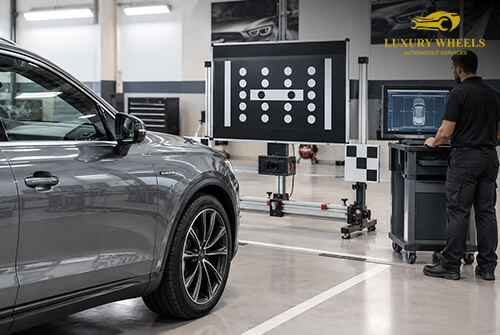
Take care of flooded luxury cars with a full diagnostic scan (OEM equipment, not generic OBD readers). The scan: More than just the broader powertrain fault codes, this provides a better understanding of which modules are faulty.
Selecting a Specialized Workshop: The Role of Expert Inspection in Al Quoz
Al Quoz is Dubai's established hub for specialist automotive workshops, including those equipped to handle complex flooded vehicle recovery. When selecting a workshop for your flood-damaged luxury car, verify the following:
- Factory-level diagnostic equipment for your specific brand (e.g., XENTRY for Mercedes, ISTA for BMW, ODIS for Audi/Porsche)
- Experience with waterlogged vehicles specifically - not just general luxury car repairs
- Ability to produce a detailed written inspection report suitable for insurance submission
Avoid workshops that offer rapid turnaround without comprehensive scanning. Speed is not the goal at this stage. Thoroughness is.
The Professional Inspection Report: Your Shield Against Future Liability
A comprehensive, signed expert inspection document from a trusted Al Quoz shop does more things for you. That gives technical detail that backs your insurance claim. It records the specific extent of repairs performed. And it also qualifies you lawfully and financially should you opt to sell the car at some point later on - in other words, clear documentation of what was damaged and what was repaired by a professional.
Retain this report permanently in your vehicle's service history file.
The Silent Killers: Long-Term Damage and Resale Value
Combatting Musty Odors and Mold Growth with Interior Sanitization
Interiors damaged by water that are not cleaned and allowed to dry within 48 to 72 hours become breeding grounds for mold and mildew. In the warm surroundings of Dubai, spores will develop effectively in as little as 2 days, with moisture trapped in carpets, seat foam, and dashboard trim.
Professionally sanitizing the inside of flooded high-end luxury vehicles includes: removing all carpets, using industrial-grade dryers to dry out subfloors, and a full treatment of all surfaces with antimicrobial agents, followed by ozone sanitization to destroy embedded odors. This is something that will never be duplicated with consumer products. A vehicle that still has a mildew odor six months after flood waters have receded is one whose interior was statistically unreported.
Identifying Rust on Seat Rails and Hidden Corrosion
Steel seat rails, floor pan reinforcements, and structural chassis members are frequent sites of post-flood corrosion in luxury vehicles. Because these components are hidden beneath carpets and trim panels, corrosion often advances significantly before it is detected.
During your professional inspection, specifically request a check of seat rail condition, sill structures, and boot floor integrity. Early-stage corrosion treated with professional rust inhibitors and protective coatings can be arrested. Late-stage structural corrosion can compromise vehicle safety and render the car unfit for repair.
Managing Your Vehicle History Report: Transparency for Future Buyers on Auto Trader UAE
The second-hand luxury car market in Dubai is quite developed. Buyers on sites such as Auto Trader UAE and Dubizzle are now starting to perform vehicle history checks before buying. A well documented and disclosed flood-damaged vehicle (painstakingly repaired) is worth a great deal more, and much more readily sellable than one which has an unclear or undisclosed pedigree.
Collaborate with your insurer and workshop to ensure all repairs are duly documented. With a completion record, an original TWIMC document, and the police report, the story of a flood-damaged vehicle can shift from being an outright disaster-maybe even valuable junk-to something much more akin to a salvageable car with repair records that ratings-challenged commercial owners sell.
A 30-Minute Action Plan to Save Your Investment
Summary Checklist of Immediate Response Steps
- Do not start the engine - prevent hydrolocking at all costs
- Disconnect the battery - cut electrical circuits immediately if safe
- Ensure personal safety - exit if water is still rising
- Document everything - photograph waterlines, interior, engine bay, and surroundings
- File a Dubai Police natural disaster report - via the app or in person
- Request a TWIMC certificate - from Dubai Police for insurance and resale use
- Call your insurer - confirm comprehensive coverage and begin the claim
- Book flatbed towing - insurer-approved, luxury-vehicle specialist only
- Arrange professional inspection - full diagnostic scan at a specialist Al Quoz workshop
- Authorize interior sanitization and fluid analysis - within 48 hours
Final Advice on Maintaining Luxury Car Value in the UAE's Changing Climate
Dubai's climate is changing. This April 2024 storm was not the last extreme weather in the UAE. Luxury car owners should take the initiative and review their insurance policies every year, make sure that natural disasters are covered, and be fully aware of the Dubai Police reporting process before needing it.
The business owners who fare the best through flood events are not necessarily those who get lucky. They are the ones who knew exactly what to do + did it right away.
If your vehicle has recently suffered flood damage, or you want a pre-emptive inspection to assess your car's vulnerability before the next storm season, contact the specialist team at Luxury Wheels today. Our Al Quoz workshop provides manufacturer-grade diagnostic scanning, full flood damage assessments, and professionally documented inspection reports trusted by insurers and buyers across the UAE.