Table of Contents
- Understanding the Vulnerability of McLaren's SSG in the UAE
- Warning Signs: Symptoms of a Failing or Overheating SSG Gearbox
- Root Causes of Transmission Overheating in Supercars
- Professional Diagnosis: Beyond the Basic OBD-II Scanner
- Estimated Repair Costs for McLaren SSG Issues in Dubai
- Strategic Asset Management: Protecting Your McLaren's Resale Value
- Preventive Maintenance: Strategies for the Dubai Climate
- Technical Authority: Choosing the Right Service Provider in the UAE
- Maintaining the Performance Edge of Your McLaren SSG
- Frequently Asked Questions (FAQs)
McLaren SSG gearbox overheating is one of the most reported technical issues among supercar owners navigating Dubai's stop-and-go traffic-and for good reason. The Seamless Shift Gearbox (SSG), McLaren's seven-speed dual-clutch transmission, was engineered for performance circuits and open-road driving, not 45-minute queues on Sheikh Zayed Road in 48°C heat. This guide covers everything McLaren owners in the UAE need to know: the warning signs of SSG transmission overheating, the root causes, realistic repair costs in Dubai, and preventive steps to keep your McLaren performing at its peak.
Key Takeaways
- McLaren SSG gearbox overheating is primarily caused by a combination of Dubai's extreme ambient temperatures and the heat-generating nature of dual-clutch systems during slow urban traffic.
- Early symptoms-including limp mode, clutch slip, and erratic shifting-are often the first signs of a developing SSG transmission problem, and they should never be ignored.
- Repair costs for McLaren gearbox repair in Dubai range from minor fluid service to full transmission overhaul, with pricing heavily influenced by parts availability and labor complexity.
- Generic OBD-II scanners cannot fully diagnose McLaren SSG problems; McLaren-specific diagnostic software is essential.
- Proactive maintenance-including upgraded cooling components and specialized fluid intervals-can significantly extend SSG gearbox lifespan in the UAE climate.
- Luxury Wheels Automobile in Al Quoz, Dubai, provides factory-grade McLaren SSG transmission diagnostics and repair with genuine-quality parts and transparent pricing.
Understanding the Vulnerability of McLaren's Seamless Shift Gearbox (SSG) in the UAE
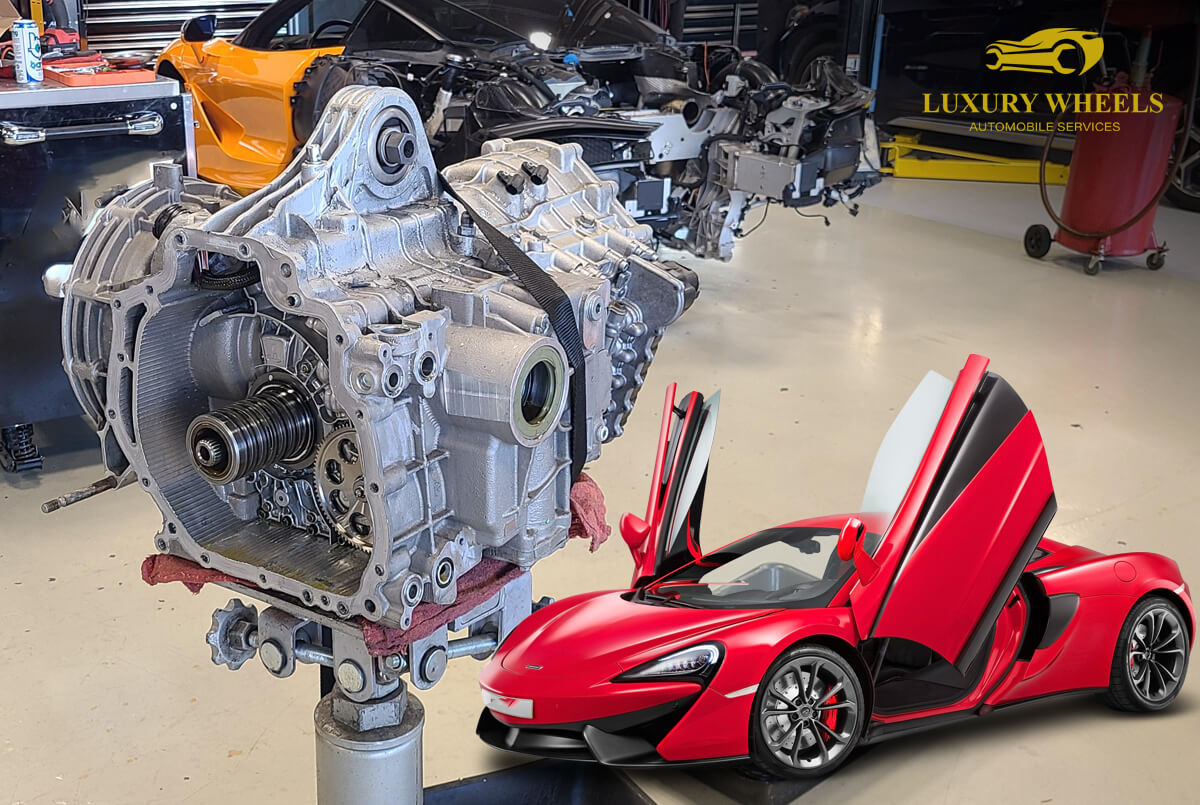
McLaren Seamless Shift Gearbox, and one of the most sophisticated gearboxes to ever be fitted on a road car. The seven-speed SSG, developed from Formula 1 technology, also provides instant gear changes without any disruption of power. But all that engineering sophistication carries with it a thermal sensitivity which becomes pernicious in the frigid climate of the UAE.
The Engineering Paradox: High Performance vs. Urban Heat Soak
The SSG system was crafted by McLaren to only function within a specific temperature envelope. On the track or laid-out highway, airflow through the mid-engine bay continuously clears away heat. The airflow collapses completely in the urban traffic of Dubai.
The actual problem as such is nothing other than heat soak. Well, when a McLaren 720S, 570S or Artura sits idling in peak-hour traffic on Al Khail Road, its transmission generates friction heat as clutches engage and disengage over and over-the same heat it was never engineered to dissipate without the help of forward motion. This results in a slow, steady increase in transmission oil temp that can force the SSG into limp modes before the driver even knows something is wrong.
How Dubai's Stop-and-Go Traffic Taxes the Dual-Clutch System
A dual-clutch transmission works with two sets of clutch packs: one for odd gears and the other for even ones. In flowing traffic, clutch disengaging behavior is momentary and friction at best. If the car loitered at low speeds in automatic, the clutch packs were constantly riding a partial engagement-especially in stop-and-go conditions.
Such micro-slippage occurs repeatedly and generates disproportionate excess heat. With the ambient temperatures of Dubai (often above 45°C in summer) and the abilities of the oil cooler to manage, transmission oil begins to heat up faster than what the SSG can cool. This gets even worse with McLaren rear mid-engine cars.
The Mid-Engine Layout: Why Airflow Management Is Critical for the SSG
All McLarens from the MP4-12C to the 750S place an engine and transmission immediately behind the driver's seat, encased within a carbon fiber tub. This arrangement is an optimal configuration in terms of weight distribution, but only a small area has thermal mass.
Air is channelled at speed through the rear radiators and over the powertrain. That forcing effect stops when we are not exercising or are at rest. The SSG gearbox, which is mounted directly beneath and behind the twin-turbo V8, absorbs radiated heat from both the engine and exhaust system. If there is not enough forward movement to bring in that air, though, the temperatures rise fast.
Warning Signs: Symptoms of a Failing or Overheating SSG Gearbox
The best thing is you can spend thousands of dirhams if you are late looking to solve the problems with your McLaren SSG gearbox. To help ensure you have the most effective reductions in noise or vibrations, what follows is a list of the reliable symptoms of SSG transmission overheating or mechanical degradation.
Transmission Warning Lights and 'Limp Mode' Activation
A lit-up transmission warning light on the instrument cluster is the most obvious indication-oftentimes a message stating "Gearbox Fault" or "Transmission Hot" will also be displayed. If SSG oil temp exceeds the safe limit, the car's ECU will invoke limp mode and force it into only one gear (most likely 3rd) to preserve internal parts.
So Limp mode is a reaction but not the answer. Should your McLaren go into limp mode on the trafficked streets of Dubai, driving it home-even at a snail's pace-may cause irreparable damage to the mechatronic unit and clutch assemblies.
Erratic Shifting, Hesitation, and Clutch Slip Characteristics
Before a full warning light appears, the SSG often signals distress through subtle behavioral changes:
- Delayed gear engagement: A noticeable pause between throttle input and the car accelerating.
- Clutch slip under load: The engine revs rise independently of vehicle speed, particularly when pulling away from junctions.
- Jerky low-speed shifts: The car lurches or hesitates when changing between first and second gear in slow traffic.
- Reluctance to downshift: The transmission holds higher gears longer than normal, especially during light braking.
These symptoms are common across the McLaren 570S, 600LT, 650S, 720S, and GT, and they frequently intensify after extended time in traffic.
Erratic Shifting, Hesitation, and Clutch Slip Characteristics
Before a full warning light appears, the SSG often signals distress through subtle behavioral changes:
- Delayed gear engagement: A noticeable pause between throttle input and the car accelerating.
- Clutch slip under load: The engine revs rise independently of vehicle speed, particularly when pulling away from junctions.
- Jerky low-speed shifts: The car lurches or hesitates when changing between first and second gear in slow traffic.
- Reluctance to downshift: The transmission holds higher gears longer than normal, especially during light braking.
These symptoms are common across the McLaren 570S, 600LT, 650S, 720S, and GT, and they frequently intensify after extended time in traffic.
Unusual Noises and Burning Smells from the Rear Mid-Engine Bay
The presence of a burning odor from behind the cabin-different from normal smells of brakes or tires-is one key symptom that clutch packs are overheating. Thermally degraded transmission fluid can create a rancid smell that comes into the cabin via back air vents.
Unusual noises to watch for include:
- A grinding or rattling sound during gear selection
- A whining noise at specific RPM ranges
- Clunking when selecting reverse or engaging from a standstill
None of these sounds should be dismissed as "normal" for a high-performance vehicle.
Sudden Loss of Reverse or Odd/Even Gear Selection
The McLaren SSG, it features a dual-clutch architecture with odd-numbered gear sets on one clutch and even-numbered ones on another pack. One clutch assembly breaking can fail either odd gears (1st, 3rd, 5th, and 7th) or even gears (2nd, 4th, and 6th)-a unique failure pattern not observed in conventional automatic transmissions.
The loss of reverse gear is especially frequent as one of the first warning symptoms in case of imminent Mechatronic unit failure or gradual loss of hydraulic pressure. The SSG must be immediately assessed professionally if your McLaren loses reverse in a parked position.
Root Causes of McLaren SSG Gearbox Overheating in Dubai
Understanding why the SSG overheats is essential to addressing the problem effectively-and to preventing recurrence after repair.
Thermal Degradation of Transmission Fluid in High-Ambient Temperatures
With the SSG, McLaren specifies a specific grade of dual-clutch transmission fluid. Under standard European operating conditions, this fluid withstands the intended service interval without detectable impact to its viscosity/lubrication properties.
That means the high ambient temperatures on this side of the world accelerate both oxidation and thermal breakdown in transmission fluid even more. A fluid that might be effective for 40,000 km in a cooler environment can break down significantly over the course of just 20,000–25,000 km of UAE driving-especially with regular exposure to stop-and-go traffic. Contaminated fluid can no longer effectively transfer heat and lubricate clutch surfaces, and causes premature wear in an already hot-running system.
Mechatronic Unit and Internal Sensor Sensitivity
At its heart, the SSG features a mechatronic unit that is a combination hydraulic/electronic control module that controls every shift via an intricate system of solenoids, sensors, and pressure regulators. This cell is also sensitive to prolonged high temperatures.
In addition, prolonged exposure to heat causes sensor drift where internal sensors report values that are only slightly incorrect. So the mechatronic unit begins to select gears based on this incorrect data, which translates into the rough shifting and hesitation patterns outlined above. In more advanced examples, solenoid seals wear out, leading to internal hydraulic leaks and pressure drops that also hurt performance.
Accumulator Failure and Hydraulic Pressure Drops
The SSG sends pressurized hydraulic accumulators to pre-charge the clutch packs, for rapid, seamless gear changes. An accumulator that has lost its pre-charge pressure makes the pump work harder and longer-building pressure for each shift.
If the accumulator is failing, then it can lead to the "slow, laborious" gear changes instead of those crisp, instant shifts McLaren owners expect. Conversely, the masters of all those simulated gear shifts are pounding out hundreds of extra micro-gears per journey in Dubai traffic-so it's likely to see accelerated wear on a gearbox rather faster than highway or track.
External Cooling Factors: Radiator Blockages and Cooling Fan Malfunctions
The SSG relies on active cooling through McLaren's rear radiator circuit and associated cooling fans. Two common failure points in UAE conditions are:
- Radiator blockages: Dubai's fine sand and dust partially obstruct radiator fins over time, reducing cooling efficiency even when the car is moving.
- Cooling fan faults: If a cooling fan fails or runs at reduced speed, heat that should be evacuated from the transmission oil cooler circuit accumulates within the powertrain bay.
Both issues can trigger SSG overheating even in driving conditions that would otherwise be manageable. Regular radiator cleaning is therefore a meaningful preventive measure in Dubai's environment.
Professional Diagnosis: Beyond the Basic OBD-II Scanner
So how do you use a generic code reader to diagnose McLaren SSG gearbox problems? SSG architecture: Legacy (non-OBD-OEM) companies and generic OBD-II tools naively attempt to express fault codes and their information in a translation layer that generalizes; but SSG's architecture saves fault code information in proprietary formats that cannot be fully expressed through an open solution.
Utilizing McLaren-Specific Diagnostic Software vs. Generic Tools
To communicate with the SSG's mechatronic unit, McLaren uses its own internal diagnostic software platform-often referred to as the McLaren Diagnostic Tool (MDT). This software provides:
- Real-time SSG oil temperature monitoring
- Clutch wear percentage data
- Individual solenoid status and response times
- Hydraulic pressure values across the SSG circuit
- Full fault code libraries with McLaren-specific descriptions
A generic OBD-II scanner might note a general "transmission fault," but it cannot pinpoint the specific cause of failure, whether the root of the issue is attributed to a malfunctioning solenoid, an overheating clutch pack, low accumulator pressure, or even a sensor that is on its way out. At this stage, the cost is high if a misdiagnosis occurs.
When the McLaren SSG is diagnosed at Luxury Wheels Automobile in Al Quoz, Dubai, factory tools are used to gain access to real-time SSG levels so technicians can identify the exact mode of failure before any repair processes take place.
Condition Monitoring: Using Data to Spot Trouble Before Failure
Modern SSG diagnostics do not only read stored fault codes. Specialists at McLaren have live data logging capability to monitor how the transmission operates through a multi-speed operating cycle-this can expose degradation patterns that cannot yet trigger warning lights.
This approach, known as condition monitoring, allows technicians to identify:
- Rising clutch pack temperatures under defined load conditions
- Solenoid response times that are lengthening gradually
- Hydraulic pressure that recovers more slowly than factory specifications
Identifying these trends early means intervention before a breakdown occurs-and before a minor repair becomes a major overhaul.
Assessing the Health of Solenoids and Control Boards
Testing a solenoid is a specialized process that exposes the solenoids to specific electrical signals and records response timings & flow rates using unique test equipment. Measuring control boards requires electrical testing and an analytical search for heat issues, rust defects, or split solder joints.
They need specialist assessments that are not offered by non-specialist workshops, making them a crucial part in the accurate diagnosis of SSG. Some solenoids pass electrical tests, yet are compromised hydraulically-only the best McLaren-trained technicians with the correct equipment can distinguish reliably between the two.
Estimated Repair Costs for McLaren SSG Issues in Dubai
McLaren gearbox repair costs in Dubai vary significantly depending on the severity of the fault, the specific model, and parts availability. The table below provides a structured overview of typical repair categories.
| Repair Category | Common Work Involved | Estimated Cost Range (AED) |
|---|---|---|
| Minor Repairs | Fluid flush, sensor replacement, software update | AED 1,500 – 5,000 |
| Moderate Repairs | Mechatronic unit refurbishment or replacement | AED 12,000 – 35,000 |
| Major Repairs | Full SSG gearbox overhaul, clutch pack replacement | AED 45,000 – 120,000+ |
| Cooling System | Radiator cleaning, fan replacement, oil cooler | AED 2,500 – 8,000 |
Note: Figures are indicative ranges for the UAE market. Final costs depend on the specific model, parts sourced, and labor time. Contact Luxury Wheels Automobile for a precise assessment of your vehicle.
Minor Repairs: Sensor Replacements and Specialized Fluid Flushes
If the SSG fault is diagnosed promptly-before any clutch or mechatronic damage occurs-the repair usually just involves replacing a failed sensor and performing an appropriate fluid flush using the correct McLaren-approved dual-clutch fluid.
It is also time to check and clean that SSG oil cooler, and check that the cooling fans are running properly. At least a fluid service with the correct fluid specification-not some generic dual-clutch fluid-will make SSG shifts function properly and lower operating temperatures significantly.
Moderate Repairs: Mechatronic Unit Refurbishment vs. Replacement
If the mechatronic unit has been damaged as a result of excess heat build-up, there are two options: either repair (refurbishment) of the present unit or a complete replacement.
Refurbishment - executed by SSG with experience specific to remanufacturing SSG units - takes place within the same housing, replacing solenoids, seals, and sensors that have failed. As long as the housing and control board are intact, this strategy can provide significant cost savings over a new OEM replacement unit. New OEM mechatronic units are obtainable from McLaren's parts network, but at a steep premium - especially considering that supply chain lead times can significantly extend the wait time.
Major Repairs: Full Gearbox Overhaul and Labor Hours Breakdown
SSG gearbox from bumper to bumper-putting it back together when clutch packs wear out, bearings fail, or internal hydraulic components are torn asunder-is a time-consuming exercise. Even just removing the SSG will have the rear subframe and powertrain assembly torn apart, a process that could consume 15–25 hours of skilled labor time by itself.
The process includes complete tear-down of the motor, vapour PA/MA wash as well as inspection of all internal components, rebushing or replacing any worn parts and assembly to factory tolerances; all controlled using specialised diagnostic software before driving the car back on the road. Carried out by McLaren-trained experts, a full SSG overhaul returns transmission functionality to factory conditions.
The Impact of Supply Chain Disruptions on Specialized Component Pricing
SSG components for the McLaren are not kept in stock anywhere on the planet. Some areas, especially OEM mechatronic assemblies, however, certain clutch pack components can have lead times taking multiple weeks based on factory build schedules and regional distributor stock availability.
And for those with McLaren in Dubai, plan: Parts lead time. An accident repair workshop with established connections with McLaren's parts supply chain-and expertise in sourcing quality repro parts when required-can significantly trim both wait times and total repair costs, all without sacrificing quality.
Strategic Asset Management: Protecting Your McLaren's Resale Value
This in turn affects how much your McLaren can expect on resale in the UAE market, with service history and transmission condition directly affecting sector pricing. SSG health is scrutinized by buyers and valuation professionals alike, as all commercial maintenance performed to your specific vehicle can be quantified into monetary value.
Managing the Total Cost of Ownership (TCO) Through Proactive Care
Overall TCO/TCA for a McLaren in Dubai is a combination of purchase price, insurance, fuel and maintenance-but for many owners an unplanned SSG rebuild is the largest unauthorised expense ever incurred.
This risk can be reduced significantly by planning regular maintenance. At the structured SSG service intervals (i.e. UAE adaptive fluid changes, scheduled cooling system assessment and continuous diagnostic condition monitoring), owners with their vehicles serviced in accordance with a maintenance calendar consistently report far lower unplanned repair expenditure across an ownership period of three to five years.
OEM Parts vs. High-Quality Aftermarket Solutions: Which Is Right for the SSG?
OEM or OEM-approved parts are likely the correct specification for safety-critical and performance-critical components within the SSG-clutch packs, mechatronic solenoids, hydraulic accumulators. These parts are made to the tolerances needed by McLaren's engineering team and approved for use within SSG's hydraulic and electronic package.
However, high-quality aftermarket alternatives may be suitable for ancillary components including the sensors, cooling hoses, or fasteners. Always ensure that it is a trained McLaren technician who understands the particular application and failure mode that you are addressing.
Luxury Wheels Automobile covers all McLaren SSG repairs with genuine and OEM-approved parts, helping guarantee impressive performance throughout ownership and solid resale values as well.
Navigating Warranty Coverage for Transmission Repairs in the UAE
UAE consumer protection legislation allows vehicle owners to go to specialist garages for servicing without automatically voiding the manufacturer's warranty, although this must be accompanied by the use of OEM standard parts and proper paperwork.
As such, SSG repairs done outside an official dealership should not compromise the warranty protection for McLaren owners in Dubai. Selecting an independent specialist with a proven record for the use of original parts can provide comparable technical results at lower costs.
Preventive Maintenance: Strategies for the Dubai Climate
Prevention is substantially less expensive than repair when it comes to McLaren SSG gearbox problems. The UAE climate requires a modified approach to maintenance intervals and component monitoring compared to the standard European schedule.
The Role of Predictive Maintenance in Extending Gearbox MTBF
McLaren SSG gearbox problems are massively cheaper to prevent than to cure. Due to the climate in the UAE, it would also differ from its European counterpart with regard to maintenance intervals and component monitoring.
- Transmission temperature logging: Recording peak SSG oil temperatures during typical UAE driving cycles to identify when intervention is required.
- Fluid condition analysis: Testing transmission fluid viscosity and contamination level at defined intervals rather than relying solely on mileage or time.
- Solenoid response monitoring: Tracking solenoid response times at each service to detect drift before it reaches fault threshold.
These data-driven inputs allow technicians to time interventions precisely, replacing components before they fail rather than after.
Upgraded Cooling Components for High-Ambient Environments
Several aftermarket and OEM-approved upgrades are available to improve SSG thermal management in extreme heat environments:
- Uprated transmission oil coolers: Larger or higher-efficiency cooler cores that dissipate heat more effectively under low-speed, high-ambient conditions.
- Enhanced cooling fan control calibration: Adjusting fan activation thresholds to begin active cooling at lower SSG oil temperatures.
- Thermally insulated heat shields: Reducing radiated heat transfer from exhaust components to the SSG housing.
These modifications are particularly relevant for McLaren owners in Dubai who use their cars frequently in urban conditions or for valet parking in enclosed spaces.
Optimal Driving Habits to Minimize Clutch Wear During Peak Traffic Hours
Driving technique makes a meaningful difference to SSG longevity in Dubai traffic. The following practices reduce clutch pack wear and thermal stress:
- Use sport or automatic mode, not manual mode, in slow traffic: Manual mode keeps a fixed gear engaged, increasing clutch micro-slip. Sport auto mode manages the clutch more efficiently at low speeds.
- Allow the car to cool before switching off: Sitting at idle for 2–3 minutes after heavy traffic allows the cooling fans to continue operating and normalize transmission temperature before shutdown.
- Avoid excessive creep: Where traffic conditions allow, braking to a complete stop and releasing the clutch load is preferable to maintaining a slow crawl with the clutch partially engaged.
- Time journeys to avoid peak congestion: Where feasible, scheduling trips outside peak hours (7:00–9:00 AM and 5:00–8:00 PM) meaningfully reduces the thermal load on the SSG.
Maintaining the Performance Edge of Your McLaren SSG
McLaren SSG gearbox overheating season in Dubai isn't an unavoidable consequence of UAE ownership - it's a controllable risk if approached correctly with the right knowledge and the right service partner. Those owners with the lowest unplanned repair costs are always the ones who recognised early symptoms and who serve their units at intervals that suit more closely what our climate demands, but most importantly work with suitably qualified technicians familiar with how an SSG is supposed to perform.
This proactive management of your SSG helps preserve resale value because buyers are demanding documentation confirming the health of fifty-year-old transmissions as part of any buy job pre-purchase inspection.
If your McLaren is experiencing any of the symptoms described in this guide-limp mode activation, erratic shifting, clutch slip, loss of reverse, un usual smells from the rear engine bay-experts advise early diagnostics by a specialist are the cheapest solution on offer.
Contact Luxury Wheels Automobile in Al Quoz, Dubai, to book a McLaren SSG diagnostic today. Call +971 52 203 0006 to schedule your appointment.