Table of Contents
- The Dawn of the Software-Defined Luxury Vehicle
- The Architecture of an Update: From Cloud to Cockpit
- Enhancing the Driving Experience: What OTA Actually Updates
- The White Glove User Experience: How Luxury Brands Manage Downtime
- Beyond Maintenance: OTA as a Tool for Value Appreciation
- Security, Sovereignty, and Data Privacy in High-End Vehicles
- The Human Touch: When OTA Reaches Its Limits
- Looking Ahead: The Future of Luxury Mobility
- Conclusion: The Car That Grows With You
- Why Choose Luxury Wheels in Dubai?
- Frequently Asked Questions
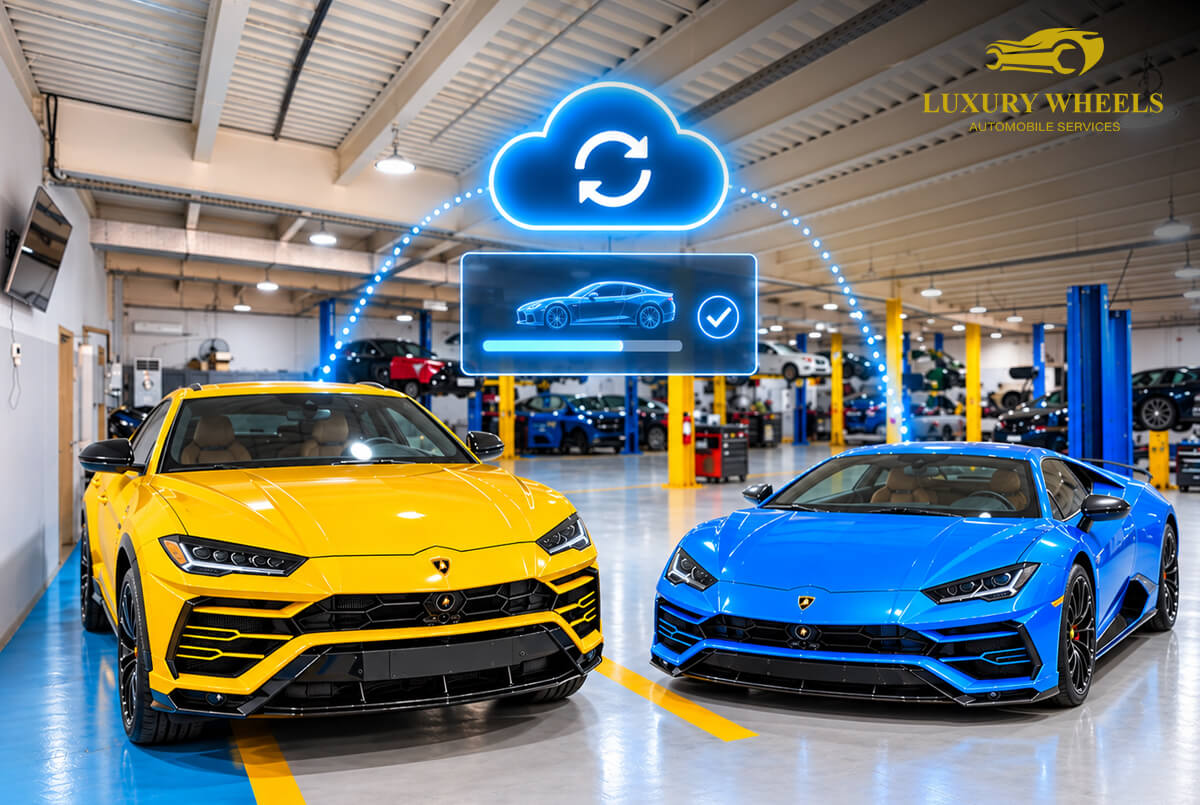
Over-the-air software updates for luxury vehicles let manufacturers improve your car remotely, through a secure wireless connection, without a workshop visit. They can refine performance, strengthen safety systems, and add new features while the car sits in your driveway in Dubai Hills or your building's garage in Downtown.
This guide explains what happens behind the screen, from cloud servers to individual control modules. It also covers why OTA matters for long-term ownership and resale, and when your vehicle still needs a specialist's hands.
The Dawn of the Software-Defined Luxury Vehicle
Shifting from static hardware to dynamic ecosystems
A decade ago, a car's abilities were fixed the day it left the factory. Software-defined vehicles change that. Many functions now live in code rather than in mechanical parts. As a result, the same hardware can gain new capabilities, sharper calibration, and better efficiency throughout years of ownership.
Why the luxury segment is leading the OTA revolution
Premium buyers expect their cars to keep pace with their phones, watches, and homes. Luxury brands also fit more sensors, processing power, and connected car technology than mass-market models do. That richer hardware gives automotive OTA technology more to improve, which is why flagship models usually receive major upgrades first.
The concept of car appreciation vs. traditional depreciation
Traditional cars lose value as their technology ages. A connected luxury model that keeps receiving updates holds its relevance much longer. Software alone won't stop depreciation, but a well-maintained, fully updated car is noticeably easier to sell. Buyers also tend to pay more for one.
The Architecture of an Update: From Cloud to Cockpit
The role of 5G and high-speed Wi-Fi connectivity in luxury telematics
Every update starts with vehicle-to-cloud communication. A telematics control unit with an embedded SIM handles 4G or 5G vehicle connectivity on the move. High-speed Wi-Fi connectivity at home suits larger packages. The UAE's strong mobile network coverage makes cloud-based vehicle updates especially reliable here.
The Master Gateway: Managing ECU and firmware interactions
A modern luxury car can contain over 100 electronic control units. The central gateway acts as a gatekeeper between them. It receives the package, confirms which modules need it, and distributes vehicle firmware updates in the correct order. It also keeps critical systems such as braking isolated from infotainment networks.
Delta Updates: Why your update takes 10 minutes instead of an hour
Manufacturers rarely send a complete software image. A delta update contains only the code that has changed between versions, which can shrink the file dramatically. Smaller downloads use less data and install faster. They also reduce the time your car is unavailable.
Edge Computing: How the vehicle processes data before it reaches the cloud
Your car does not upload every sensor reading. Onboard processors filter, compress, and analyze data locally, then send only meaningful insights to the cloud. This edge approach saves bandwidth, speeds up decisions, and limits how much personal data ever leaves the vehicle.
Enhancing the Driving Experience: What OTA Actually Updates
Performance tuning: Boosting horsepower and battery thermal management
Some manufacturers have used OTA updates to unlock extra power or refine throttle response. For electric and hybrid models, battery thermal management updates matter even more in Dubai's 45°C summers. Better cooling logic protects battery health, steadies charging speeds, and preserves range.
Dynamic ride quality: Refining active suspension and chassis control
Adaptive dampers and air suspension depend on software that reads the road many times per second. Engineers can adjust these algorithms after launch. A recalibration can make a car calmer on Sheikh Zayed Road and more composed on mountain roads toward Hatta.
The digital cabin: Evolution of infotainment, ambient lighting, and UI/UX
The cabin is where owners notice luxury vehicle software updates most often. New voice assistant abilities, streaming apps, and navigation upgrades arrive regularly. Refreshed menus and ambient lighting themes do too. Each change makes daily use smoother and the interior feel current.
ADAS refinement: Continuous improvement of safety and autonomous features
Advanced driver assistance systems learn from millions of kilometers of fleet data. Updates can improve lane centering, adaptive cruise behavior, and object recognition. Over time, a car's safety performance can get better without changing a single camera or radar sensor.
The White Glove User Experience: How Luxury Brands Manage Downtime
Scheduling and background downloads: Ensuring the car is always ready for the owner
Downloads usually happen quietly in the background while you drive. Installation waits for a time you approve, often overnight. Many brands also require a minimum battery charge first, so your car never wakes up unable to start or short on range.
A/B Partitioning: The fail-safe method to prevent bricking and system failures
Many control units store two copies of their software. The update installs on the inactive partition while the current version keeps running. If validation fails, the system simply reverts to the working copy. This design greatly reduces the risk of a "bricked" module.
Notification systems: Providing transparency without digital intrusion
Good notifications are clear and brief. The car or companion app explains what is changing, how long installation will take, and whether action is needed. Owners stay informed without frequent pop-ups distracting them during the drive.
Remote Diagnostics: How the car reports issues before the driver notices them
Vehicle telematics systems continuously monitor fault codes, battery voltage, and module health. When something drifts outside normal limits, the data can reach the manufacturer or service team early. Some issues get fixed remotely. Others lead to a precise workshop booking instead of guesswork.
Beyond Maintenance: OTA as a Tool for Value Appreciation
Future-proofing: Keeping a five-year-old vehicle feeling current
A five-year-old flagship with current software can feel closer to a new model than an outdated one. Fresh maps, interface upgrades, and improved assistance systems extend its useful life. For collectors and investors, documented software history adds credibility at resale.
The convenience of remote recalls: Eliminating the dealership visit
Many recalls are now software-related. Over-the-air vehicle software updates can resolve them within days rather than weeks, with no service appointment. That convenience saves time and also keeps the vehicle's safety and compliance record clean.
Features-on-Demand: Unlocking premium capabilities post-purchase
Some brands let owners activate features such as enhanced performance or extra driver assistance after purchase. These may be offered as one-time payments or subscriptions. Before buying a used car, check which features belong to the car and which ones belong to the previous owner's account.
Security, Sovereignty, and Data Privacy in High-End Vehicles
End-to-end encryption and digital signatures: Validating the source
Every legitimate package is encrypted in transit and cryptographically signed by the manufacturer. The gateway checks that signature before installing anything. Frameworks such as Uptane help ensure that a tampered or fake file is rejected automatically.
Managing owner privacy: The balance between telemetry and anonymity
Connected cars generate location, driving, and usage data. Reputable brands let owners control what gets shared, and they anonymize fleet data used for development. Review your privacy settings in the app, especially before transferring or selling the vehicle.
Cybersecurity protocols: Protecting against remote vehicle vulnerabilities
Global standards such as UN Regulations R155 and R156 and ISO/SAE 21434 require manufacturers to manage cybersecurity and software updates throughout a vehicle's life. Network segmentation, intrusion detection, and regular patches all help protect the car against remote attacks.
The Human Touch: When OTA Reaches Its Limits
Understanding Professional Car Programming for deep-level firmware changes
Not every module can be flashed wirelessly. Older platforms, imported vehicles, and certain powertrain or safety controllers still need wired programming through diagnostic interfaces. Professional programming uses stable power supplies and manufacturer-level tools to install software safely.
Why hardware-integrated software still requires certified technicians
When a module, camera, or battery component is replaced, the software must be coded and calibrated to match. ADAS sensors often need physical alignment after windscreen or bumper work. These steps require trained technicians, specialized equipment, and a controlled workshop setting.
Signs your luxury vehicle may need a manual update or diagnostic check
Watch for repeated failed update attempts or warning lights that return after clearing. A frozen infotainment screen, erratic driver assistance, or unusual battery drain are also warning signs. Imported cars that fail to receive regional updates should also get a professional check.
Looking Ahead: The Future of Luxury Mobility
The roadmap to full autonomy via continuous software iterations
Higher levels of autonomy will arrive gradually, one validated software release at a time. Each update builds on real-world data and regulatory approval. Cars with capable sensors and computing power today are best placed to benefit from these advances.
AI-driven predictive maintenance: The car as a proactive concierge
Artificial intelligence can spot patterns that signal wear before a part fails. Your car may soon book its own service appointment and arrange collection. It may even order parts in advance. Maintenance becomes planned and predictable instead of reactive.
Personalization at scale: Software that learns driver habits and preferences
Future systems will remember your seat position and climate preferences, plus favorite routes and driving style. They can automatically adjust suspension and drive modes. Each driver in the household gets a car that feels made for them.
Conclusion: The Car That Grows With You
Summarizing the shift from product to service
OTA updates in luxury cars turn a one-time purchase into an evolving relationship. Secure connectivity, smart gateway architecture, and fail-safe installation keep the vehicle improving long after delivery. Owners gain performance, safety, and convenience that once required new hardware.
Final thoughts on the value of OTA for the modern luxury investor
For buyers and collectors, software health is now as important as service history. A fully updated, correctly programmed car is safer and more enjoyable to own. It is also more attractive at resale. Treat software care as part of protecting your investment.
Why Choose Luxury Wheels in Dubai?
Manufacturer updates cover a lot, but not everything. Our team brings more than a decade of hands-on experience with premium vehicle electronics. That experience covers ECU programming, module coding, ADAS calibration, and advanced diagnostics across leading luxury and performance brands.
We help owners in Dubai and across the UAE solve failed updates and resolve persistent warnings. We also bring imported or older vehicles up to date. Every job uses professional diagnostic equipment, stable power management, and clear communication about the work, the reasons for it, and the cost.
Contact Luxury Wheels today to book expert diagnostics, luxury vehicle programming, or OTA support guidance. You can also arrange a premium software consultation. Let our specialists keep your car performing exactly as its engineers intended.